Crafting meaningful jewellery for influencers and changemakers.
We’re on a mission to support influencers and social enterprises like you to create jewellery with impact;
jewellery that engages your community and drives substantial value.
Empowering you to connect with your community through the language of jewellery.
We’re on a mission to support influencers and social enterprises like you in the design and creation of quality bespoke jewellery; an innovative opportunity to drive value and foster connection with your audience.
Exceptional service.
Working across both the UK and Thailand, our dedicated support staff are here to guarantee a smooth journey. As a client of Gold Label, we promise you a passion for beautiful things and full support, transparency and efficiency from design concept to finished jewellery product. Our exceptional service is attested by the loyal clients who have been returning to us for decades.
Talented creators.
For many years we have created gold and silver collections for partner designers, retailers and wholesalers across the globe. These synergies are made possible by our versatile Development team, whose talent is in translating sketches, CADs, waxes, moulds and masters into quality fashion jewellery, silverware and giftware.
Bespoke packaging,
delivered with purpose.
Elevate the first impression of your product with an unboxing experience for your customers to remember you by. Environmental sustainability starts with the product and ends with its packaging; we’ve got all bases covered with the most sustainable possible packaging solutions we can find. From high-quality finishes to the option of adding your logo and brand name, we ensure every packaging detail is tailored to your unique vision.
Learn about our Design Development
Whether you’re entertaining one great idea or have an entire collection of pieces in mind, the design development stage is where your bespoke journey begins. Here’s what it looks like to partner with Gold Label on exclusive jewellery designs that you can call yours…
Design Support & Guidance
Our team at Thai Design strives to provide exceptional service in support of design development for all of our customers, even those just starting out. While many other suppliers have high minimum order quantities or values to exclude brands that are “too small”, we are committed to keeping barriers low enough to support artists and new businesses as they grow.

Quotations
Jewellery prices are always a bit of a moving target, but we do our best to provide the best possible guidance throughout the development process. Initially, designs are often theoretical and so we rely on experience and estimates to provide reliable guidance. As the design progresses through each step of the design process, the quote can be made more and more accurate as we get closer to a finished product. When comparing quotations, it is important to be clear on the weight and metal price, as the underlying assumptions can be quite different.

Customer Samples
It is great when a customer has a physical sample for us to work from. It provides up-front clarity on weight, texture, size, construction, and many other key elements. It is absolutely fine if a customer does not have a sample already, as the goal of design development is to provide a sample, but it does give all parties a useful head-start and frame of reference.
While customer samples are always helpful, it is important to be aware that Thai Design takes intellectual property rights seriously. We cannot copy a design unless we are confident that the design belongs to the customer.

Sketch
The value of hand-drawn sketches from customers can vary dramatically, but is not necessarily correlated to artistic ability. Simple, clear drawings with measurements are often better than elaborate, pretty pictures. A sketch is a common starting point for a design and while the destination may be a work of art, our favourite sketches are more like blueprints for architecture. Interpreting inspiration is hard to do right, and a good sketch facilitates alignment from the start.

CAD
Computer Aided Design (CAD) is a highly versatile tool, particularly for three-dimensional designs. The image can be viewed, rotated, and cut in many ways, allowing for a deep understanding of each detail. Designs can be resized or otherwise amended as needed, as often as desired. CAD is not only helpful for the designs, but can also be quite helpful for the tooling that is needed for accurate and consistent production.
When customers provide sketches, Thai Design will often convert the drawing into a CAD file that can be shared. Thai Design charges for this service, if provided, though customers are very welcome to provide their own CAD files. While Thai Design is readily able to provide CAD development, some customers prefer the direct control of selecting and communicating with a CAD artist independently. We can work either way and are happy to do what is best in the interest of the customer and the design.

3D Resin or Wax
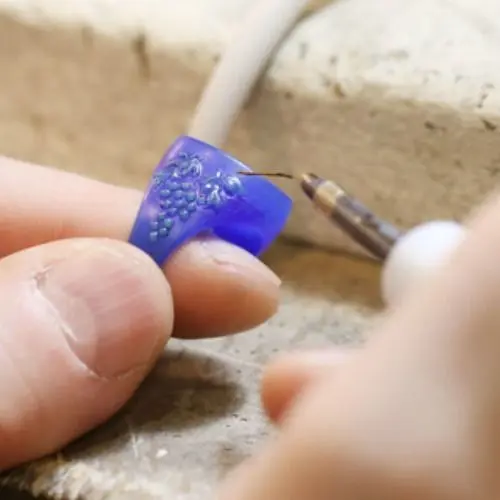
Traditionally, a talented artisan needed to carve three-dimensional representations of designs in wax with incredible skill and detail. While we are proud to preserve this craft internally, we are much more likely to rely on the crafting facility’s high-tech 3D printer. CAD files are transferred to the printer, which very precisely builds layer upon layer to create a physical prototype. Supports need to be cut and details cleaned-up, but the full process is typically completed in only a matter of hours.
It is a great way to see the design and it helps provide more accurate weight estimates for pricing quotations, but is also critical for mould-making for designs produced by casting. While customers can provide their own 3D resins or waxes, extra care is necessary when packaging for shipment as the models tend to be quite fragile. Thai Design provides a 3D printing service that is priced to be advantaged in the market. Making it an easy choice to let us provide the 3D print helps reduce uncertainty and inconsistency in the process, resulting in a better experience and end-product.
Masters, Moulds and Stamping Dies
Casting utilizes special moulds that be used to create copies from a physical master. Standards for the master must be strict as any defects will be transferred to the mould and consequently to each unit made in the mould.
Requirements vary by design, so even if a physical prototype already exists, experience is invaluable in determining of a separate master needs to be made. While Thai Design will charge for any masters or moulds made, the team will communicate with the customer at each step to promote transparency, and avoid surprises.
Stamping relies on very different dies, which are generally fabricated in metal. Maters are generally unnecessary, but the cost of tools for stamping can still sometimes seem expensive. This up-front cost may be offset by lower weights and/or lower labour, yielding a savings when tooling charges are allocated across average per unit costs.

Finished Samples
At the end of the design development process the customer receives from us. Our samples need to illustrate an understanding of what the customer wants as well as a confirmation of both technical skill in jewellery-making and quality of service. Some samples are auditions, and so we strive to deliver real results that impress and honour the opportunity we are given.
Some samples are experiments, and it is exciting to push forward and confront challenges creatively, which allows us to make collaborative decisions about production with confidence. Sample development a critical opportunity to learn, refine expectations, and plan in order to ensure that any subsequent production is successful, while mitigating unwelcome surprises.

Casting
First, a rubber mould is formed around a metal master or a silicone mould is formed around a resin print. Each expertly crafted mould is owned by the customer and safely stored to ensure that exclusivity is always maintained. When an order is placed, the corresponding mould is filled with high-performance wax, set aside, and then delicately opened to remove a perfect wax copy.
A ‘tree’ of the same design or similarly-shaped pieces is then very carefully and precisely built, ensuring consistency and efficiency. Investment material is poured into a flask positioned around the tree. Once hardened, the plaster-like material is heated in a large furnace, allowing the wax to be “burned out” and “lost”. The flask is transferred to a casting machine, where metal is melted and then dropped into the flask, neatly filling the voids of the “lost wax”. Finally, each piece is cleaned and carefully inspected before being passed to the next department.
Stamping
If our specialist team decide that lost wax casting is not the most suitable process for your unique design, the production process may instead begin with molten metal that’s poured into a form, creating a block - or ‘ingot’. The ingot is then rolled down into sheets of the required thickness for stamping, or is passed through a series of profiles and dies to create wire.
A thunderous mechanic press creates the initial form, before hand-cranked machines are used for cutting into individual components. Both machines require heavy-duty steel dies that are custom-made for each design, but can be used over and over for years. Once stamped, each component is carefully inspected before being handed over for assembly. The stamping room is like a machine shop, with an array of fabrication equipment that can also be used to create tools for other departments.
Assembly
Filing is generally the first step in the assembly process. Pieces that have been cast will bear at least one sprue - the channel that allows molten metal to be poured into the mould to create the cast - that must be filed away. Often, newly-cast pieces also emerge with a rough skin that needs smoothing.
Simple designs may only have a single component, but more complicated designs may consist of many. Soldering is the process of joining two metal surfaces to one another. Traditional jewellery torches are frequently used to heat the metal until it’s reached soldering temperature, but our crafting facility also employs modern options like a laser welder and a pulse welder that provides fluctuating currents to provide quick, seamless soldering.
Polishing
The desired finish of your jewellery is achieved by a highly skilled team using a combination of mechanical and hand polishing processes. Gold Label’s crafting facility not only boasts a state-of-the-art OTEC disc finishing unit from Germany; we also champion traditional tumble and magnetic polishing machinery. Depending on intended finish, hand-polishing may also incorporate fine grit, akin to sandpaper, to achieve a smoother and more shiny surface.
As ever, we’re committed to versatility, adaptability, and preserving time-honoured craftsmanship whilst holding space for new innovations to flourish.
Stone-setting and Hand-engraving
At Gold Label, a small team of talented artisans is responsible for setting stones of all shapes and sizes. Bevel, claw and pavé are just a few examples of the setting styles possible here. The art of stone-setting requires not only incredible precision but a degree of creativity and flexibility from each setter to ensure optimal fit and display.
Meanwhile, hand-engraving is an art form that dates back roughly 500,000 years. Sharpened steel tools called gravers, chisels, scrapers and scorpers are carefully pushed by hand, slicing the metal’s surface. It’s truly wondrous to watch a hand-engraved motif come to life, but there’s a practicality to this in-house capability, too; our hand-engravers are skilled in the clean-up of sprues on cast pieces with complex surfaces.
Stone-cutting and Inlay
Shell and stone can be cut and shaped in-house by our fantastic lapidary team. Whilst it’s possible to create cabochons for regular bezel setting, most of our designs are destined for flush inlay, where grinding and polishing carried out after the treasure is fitted and glued into position within a metal frame.
Inlay work often requires challenging shapes to be cut into incredibly small pieces, so steady hands are a necessity. The beauty of a finished inlayed piece is always balanced with the sustainable management of materials, ensuring that losses are minimised.